
Twinsburg, OH · Garage Door Service
What a Service Call Actually Covers in Twinsburg
A look at what a Twinsburg garage door service call actually involves, tied to the area's 1960s-70s housing stock and cold-climate wear on springs, openers, and tracks.
- Repairs & new doors
- Springs & openers
- Serving 7 nearby communities
The Situation
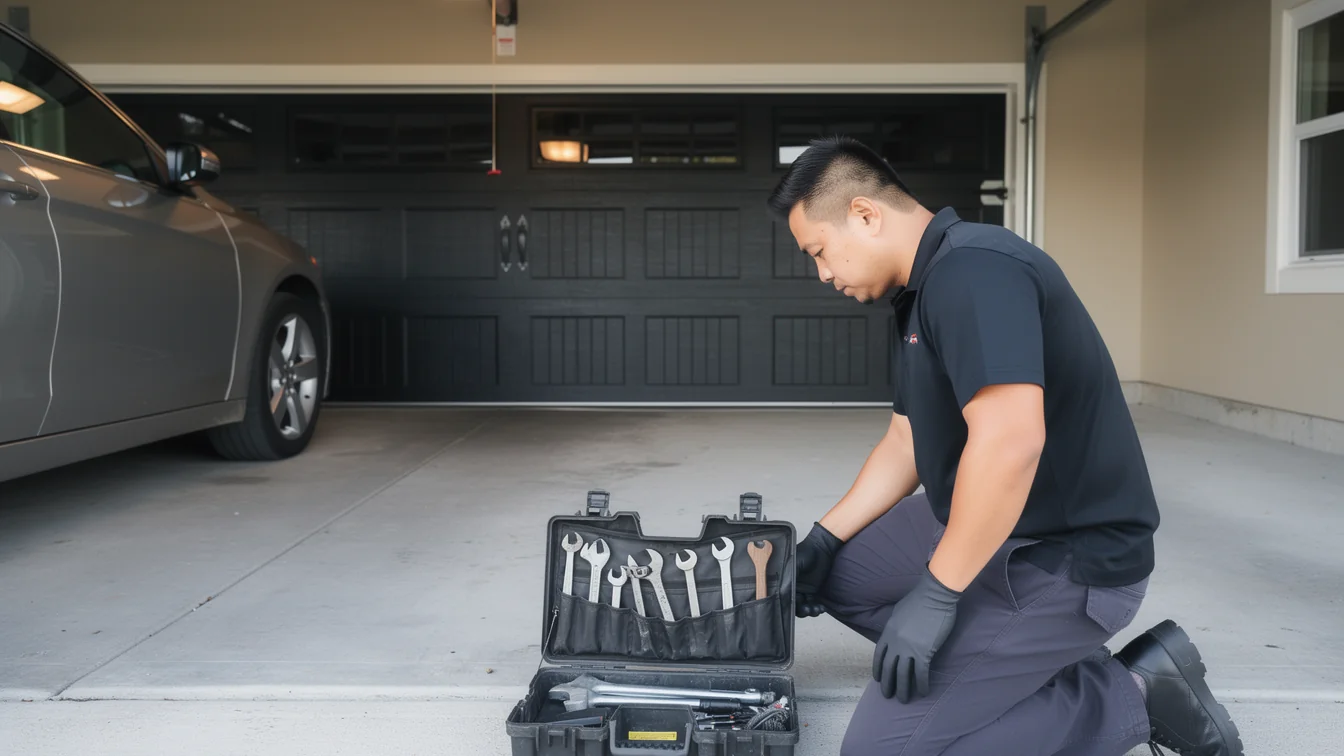
When you book a service call here, you're not getting a generic once-over. Most houses in this area went up between 1938 and 2004, with the median landing around 1967, and the bulk of the stock across the 55 named areas we work in is 1960s-70s construction. That means a tech showing up at your door is more often than not looking at a door and opener system that's been through at least one, sometimes two, full replacement cycles already - and the hardware underneath may still be original to the house or a mismatched mix from whoever patched it last. A real service call starts with figuring out what era of parts you're actually dealing with before anything gets tightened, lubricated, or swapped. That's not paperwork - it changes which wrench and which spring chart we use.
On a house built in 1967, torsion spring sizing, track gauge, and opener mounting all follow conventions that have since changed twice. Skip that step and you can true up a track that was never out of true to begin with, or load a spring that's wrong for the door weight. We walk the door before we touch it.
What Most People Get Wrong
The most common mistake is assuming a service call is one task. It isn't. A full call on a door from this housing stock covers the spring system (check wind, check cycle wear, check for the telltale rust pitting that cold-climate steel gets after a few decades), the track and rollers (alignment, not just lubrication), the opener's force and travel settings, and the cables and drums. Homeowners often ask us to "just look at the spring" because that's the part making noise, but on a house built in the 1960s or 70s, a noisy spring is frequently a symptom of a track that's shifted slightly out of plumb over fifty-plus years of settling, not an isolated spring problem.
The other thing people get wrong is thinking a service call and a tune-up are the same visit. A tune-up is maintenance on a system that's working. A service call means something is already off, and the first job is diagnosis, not just adjustment. We'll tell you straight if what you're hearing is cosmetic wear or the early stage of a failure - and we'd rather say that out loud than let a bent track go another winter.
How Local Conditions Play In
This area sits in a severe cold climate band, and that shows up directly in what a service call has to check. Steel springs lose tension and become brittle faster with repeated freeze-thaw cycling than they would in a milder climate, so a call here always includes a cycle-wear check on the torsion spring, not just a visual look. Cold also stiffens lubricant and tightens metal tolerances on rollers and tracks, which is why a door that ran fine in September can start binding or dragging once temperatures drop - that's a service call, not a tune-up, because something in the clearance has actually changed.
Openers take a hit too. Cold affects the force settings on older opener units, and on a house with 1960s-70s original framing, the opener mount itself may have shifted slightly with decades of seasonal wood movement. Part of a proper call is checking that the mount is still square to the header, because a misaligned mount reads like an opener problem but isn't one.
Leaving It Alone
Not every noise or stiff spot needs a call. If a door has always had a slight rattle on the up-cycle and nothing's changed, that's probably just the age and construction of the door talking, not a developing failure - we'd rather you save the call for something that's actually shifted. Where we draw the line: if a spring is original to a house built in this era and has never been serviced, we don't recommend just topping off lubricant and calling it fixed. A spring that old, on a door this age, is closer to the end of its life than the start, and a service call that only patches the symptom is money spent twice. We'll tell you when replacement is the honest answer instead of another repair visit.
Frequently asked questions
Is a service call the same as an annual tune-up?
No. A tune-up is scheduled maintenance on a door that's working fine. A service call means something is already wrong - noise, binding, a door that won't close - and the visit starts with diagnosis before any adjustment or part gets touched.
Why does my door act up more in winter?
This area sits in a severe cold climate band, and cold stiffens lubricant and tightens metal clearances on tracks and rollers while also affecting spring tension and opener force settings. A door that ran fine in warm months can start binding once temperatures drop, which is a real mechanical change, not just a seasonal nuisance.
My house is from the 1960s - does that matter for a service call?
Yes. Houses in this area built in that era often still have original or older-generation torsion spring sizing, track gauge, and opener mounting. A tech needs to identify that before adjusting anything, since parts and tolerances from that period don't always match current hardware.
Related garage door services in Twinsburg
More garage door guides
Book garage door service in Twinsburg
Call now or request a quote - tell us what the door is doing and where you are.