
Twinsburg, OH · Garage Door Service
When a Spring Goes in Cold Weather in Twinsburg
Twinsburg homes built mostly in the 1960s and 70s meet severe cold winters. Here's why that combination breaks torsion springs and what the fix actually involves.
- Repairs & new doors
- Springs & openers
- Serving 7 nearby communities
The Situation
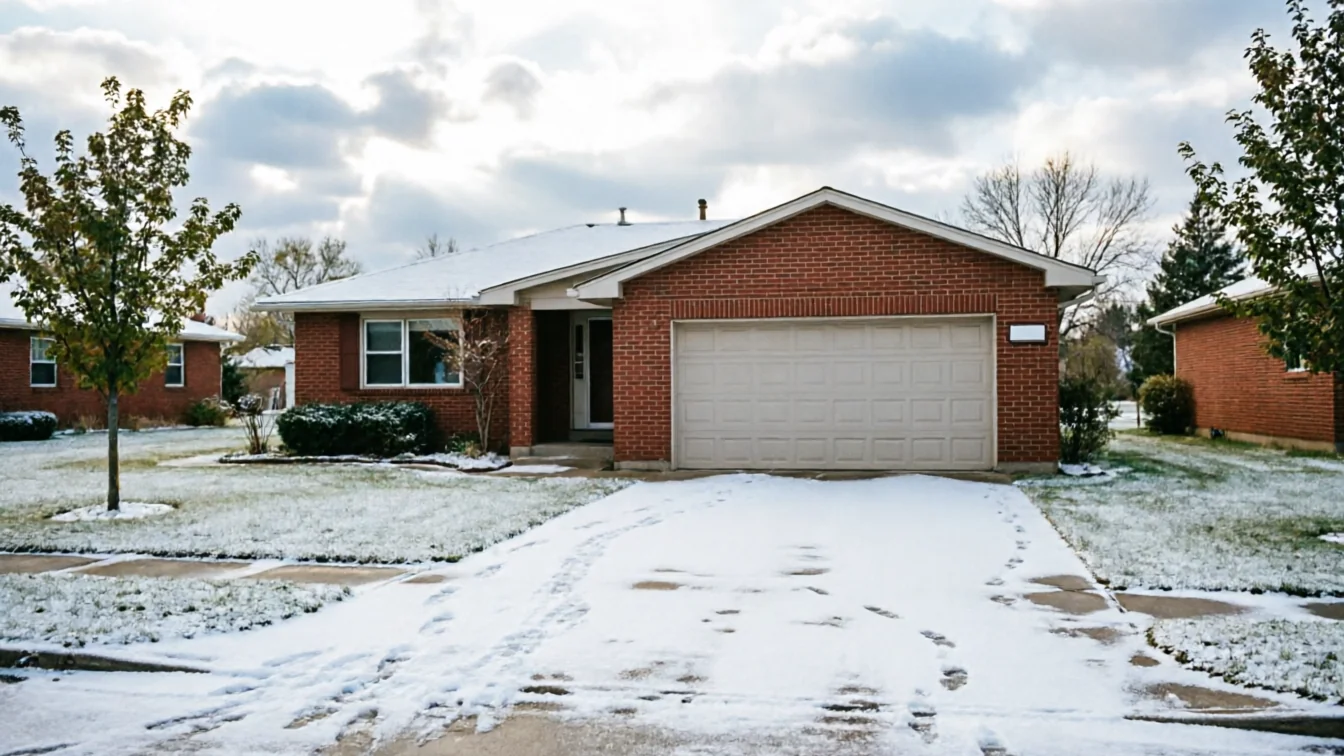
Most houses around Twinsburg went up between 1938 and 2004, with the median build year sitting at 1967, and the bulk of the stock across the area clustering in the 1960s and 70s. That matters more than people think when it comes to garage doors, because a torsion spring doesn't care how old your house is - it cares how old the spring is, and a lot of these homes are still running original or first-replacement hardware that's been through fifty-plus winters.
Steel fatigues with every cycle, and cold makes it worse. Metal contracts in low temperatures, which stiffens the coil and adds load right at the moment you're asking it to lift a door that's also heavier than usual from condensation or a little frost on the track. In a region that sits in a severe cold climate band, that's not a once-a-decade event. It's most winters.
The call we get is almost always the same: door won't budge, or it slams down with a bang because one spring let go and the other is carrying double load. On a 1960s or 70s build with the original torsion bar still in place, that's not bad luck. It's the math catching up.
What Most People Get Wrong
The common mistake is treating a cold-weather spring failure as a one-time fluke - get it fixed, move on, forget about it until next winter. On a house from this era, that's backwards. If the spring that broke was original to a home built in the 1960s or 70s, the second spring on that same bar is the same age and has seen the same cycle count. It's not a question of if, it's when, and cold weather is when.
The other mistake is assuming a repair is just a repair. On older torsion setups that predate current spring sizing standards, swapping in a modern spring without checking the wind and wire gauge against the door's actual weight leaves you with a door that's hard to lift by hand or one that slams the track going up. We size to the door in front of us, not to whatever was on the shaft before.
People also wait. A spring that's starting to sound different, or a door that's getting harder to open by hand in the morning, is giving you a warning in the cold before it fails outright. Ignoring that warning on hardware this age, in this climate, usually means the actual failure happens on the coldest morning of the year - not a convenient Tuesday afternoon.
How Local Conditions Play In
Severe cold does two things to a spring at once, and both matter here. First, the steel itself stiffens and loses a bit of flex, which raises the stress at the ends of the coil where it's already most likely to crack. Second, the door itself gets heavier in winter - a skim of ice at the bottom seal, or frost built up on an uninsulated panel, adds pounds the spring has to account for on every single lift.
On a house built in the median year of 1967, the original torsion hardware was never engineered with today's cycle-life standards in mind, and fifty-some winters of that one-two punch is exactly the kind of load history that ends in a sudden break rather than a slow fade. That's why late-December and January calls spike on the exact houses you'd expect - the 1960s and 70s stock that makes up most of the neighborhoods here.
Newer builds in the area, post-2000s, tend to run factory springs sized with more margin and see fewer cold-snap failures for now. But age catches every spring eventually, and the climate here doesn't give any of them an easy ride.
Leaving It Alone
A spring that's audibly straining or a door that's noticeably heavier than it was last month is not something to wait out until spring. In a severe cold climate, delay usually means the other spring fails too, and now you're dealing with a door that's come off track or a cable that's jumped the drum - a bigger job than the one you started with.
Here's the honest limit: we don't stock every spring size on the truck for every torsion configuration, especially the older bar setups still common on 1960s and 70s builds in this area. If your house has an original or near-original setup, there's a decent chance the exact replacement isn't a same-day part, and we'll tell you that up front rather than promise a fix we can't deliver that afternoon.
What we won't do is talk you into a full door replacement when a spring and maybe a cable is all the job needs. If the door panels and track are sound, replacing the spring is the right call, not an upsell toward something bigger.
Frequently asked questions
Why did my spring break overnight with no warning?
Cold makes steel stiffer right when the door is also heaviest from frost or condensation. On older torsion hardware, especially original equipment from a 1960s or 70s build, that combination pushes a fatigued spring past its limit. It usually isn't sudden - it's the end of a long cycle count that cold weather finishes off.
Should I replace both springs if only one broke?
If they're the same age, which they usually are on original hardware, yes. The surviving spring has the same cycle count and the same cold-weather stress as the one that failed. Replacing just one often means a second call within a season or two.
Is my house's age actually relevant to this?
Yes. Twinsburg's housing stock runs mostly 1960s to 70s, with a median build year of 1967, and a lot of that original torsion hardware is still in service. Older springs weren't engineered to current cycle-life standards, so they're more exposed to cold-weather failure than newer factory setups.
Can you always get the part the same day?
Not always. Some older torsion bar configurations from 1960s and 70s builds use spring sizes we don't carry on the truck for every job. We'll tell you honestly if yours needs an ordered part instead of promising a same-day fix we can't back up.
Related garage door services in Twinsburg
More garage door guides
Book garage door service in Twinsburg
Call now or request a quote - tell us what the door is doing and where you are.